
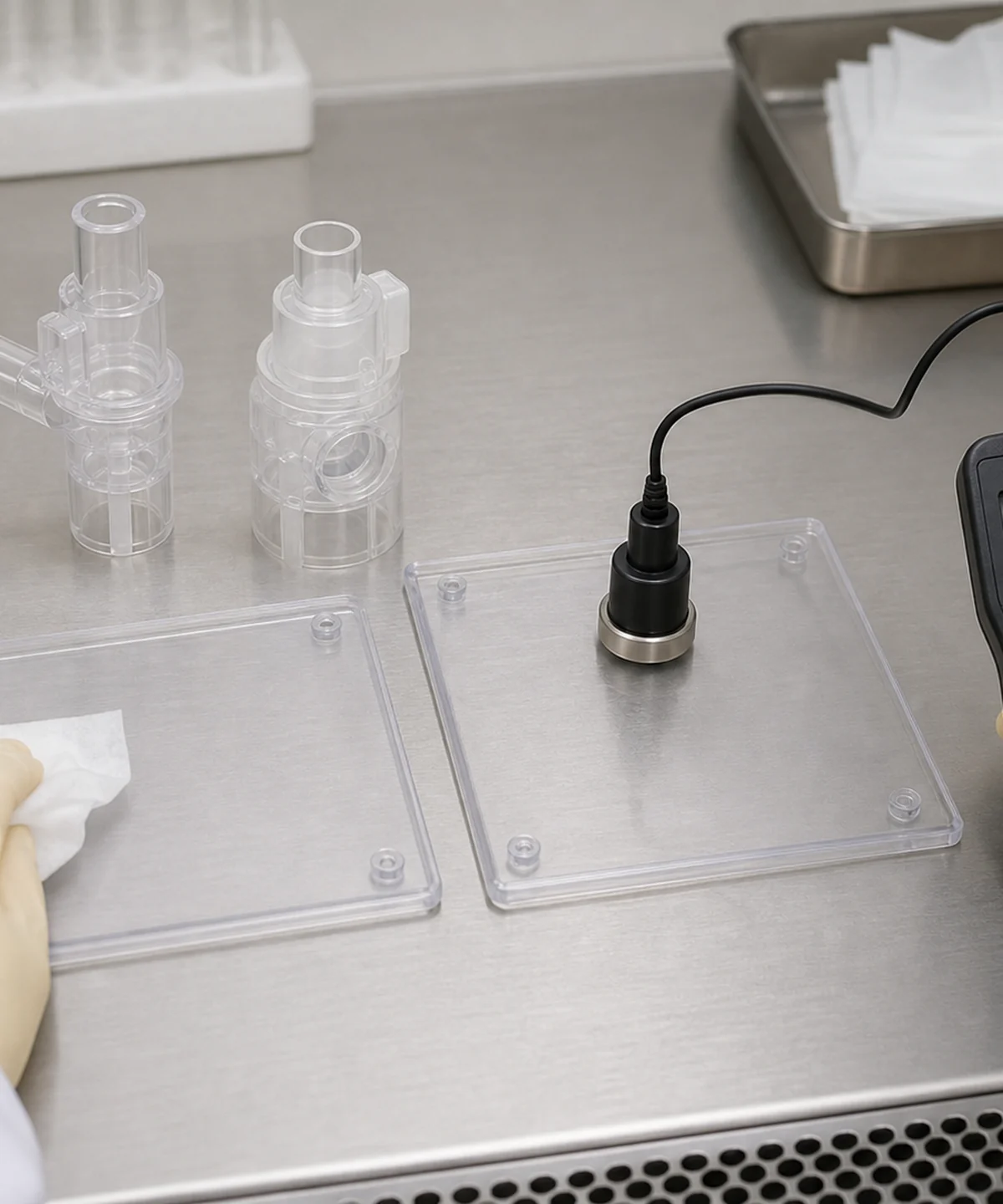
In medical devices, transparency and antistatic performance may seem contradictory. Antistatic function is usually achieved by adding conductive fillers such as carbon black, but that makes the material opaque. However, as medical equipment becomes more precise and drug-delivery accuracy requirements increase, this contradiction is being solved by new material technology.
The core role of transparent antistatic materials in medical devices is to solve two problems at the same time: static hazards and visual operation. It is both a safety guard for precise equipment operation and accurate dosing, and a visualization window that improves operating efficiency and user experience.
Static: an invisible threat in medical scenarios
Static electricity is everywhere in medical environments, but it is easy to overlook. Everyday operations such as friction and separation can generate static. The threats it creates for medical devices and patients are multifaceted:
Interference with precision electronic equipment: medical devices integrate many sensitive sensing and electronic components. Electrostatic discharge (ESD) can interfere with equipment data and may damage or destroy microelectronic components. The inner wall of a spacer chamber made from new plastic material may carry high static charge, leading to inconsistent drug delivery.
Impact on dosing accuracy and treatment effect: for inhalation devices, nebulizers and other drug-delivery equipment, static causes fine drug particles to adhere to the device inner wall. This means patients may not inhale enough medication. For asthma and other treatments that require precise dose control, the impact can be serious. If a spacer chamber has no antistatic function, static can make medication adhere to the chamber wall and directly affect dosing accuracy.
Dust adsorption and device contamination: static attracts dust and microorganisms in the air like a magnet, contaminating device surfaces and introducing infection risk during surgery or treatment.
Flammable and explosive risks: in oxygen-rich environments or operating rooms using flammable anesthetics, sparks produced by electrostatic discharge may become ignition sources and cause serious safety accidents.
Why transparency is necessary: visualization drives material innovation
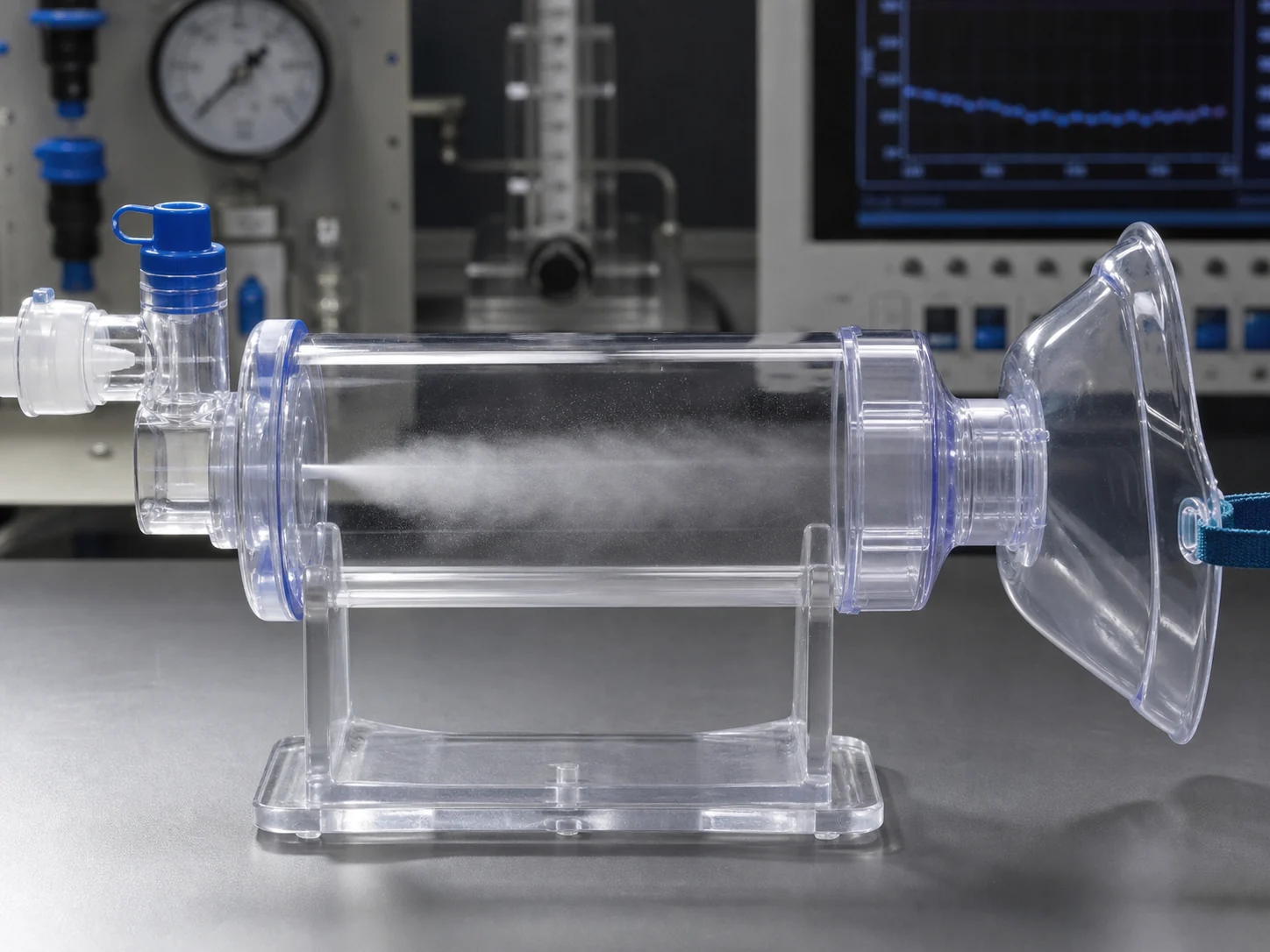
In addition to solving the static problems above, medical scenarios have rigid requirements for transparency. Transparent materials allow medical staff and patients to directly observe remaining liquid, atomization status or internal equipment operation. In some high-precision treatments, such as brachytherapy where radioactive seeds are implanted into tumors, friction-generated static can prevent seeds from accurately reaching the target position. This requires guiding or positioning parts to be both transparent and antistatic.
Why traditional solutions do not work
Early medical devices mostly relied on surface coatings or additives to dissipate static. But these approaches have fatal weaknesses: failure in low-humidity environments, degradation over time or blooming, and inability to meet medical equipment requirements for long-term stability and repeated disinfection. The inner wall of a spacer chamber made from new plastic material may carry high static charge. If treated by coating, the effect decays with use and cleaning.
Therefore, the industry has turned to polymeric permanent antistatic technology, which builds a conductive network inside the material matrix to achieve intrinsic antistatic performance.
Customer case: the precise dosing problem of nebulizer spacer chambers
In nebulized treatment for respiratory diseases, the spacer chamber is a key accessory. Its function is to temporarily hold aerosolized medication so the patient has enough time to inhale it. But there is a hidden engineering problem here: static adsorption causes inaccurate dosing.
During nebulization in an ordinary plastic spacer chamber, aerosol particles rub against the chamber wall and generate static charge. Charged aerosol particles are adsorbed on the inner wall and cannot be inhaled by the patient. Studies have confirmed that static on the inner wall of spacer chambers significantly increases the variability of respirable dose, and this problem becomes more serious under low humidity. A medication dose that should be 50 micrograms may become only 30 micrograms because of static adsorption. For asthma and other diseases that require precise dose control, this deviation may directly affect treatment outcome.
The difficulty faced by a medical nebulizer manufacturer
A medical nebulizer manufacturer in East China supplies spacer chamber products to multiple hospitals and home medical channels. The customer required the spacer chamber to meet three conditions: transparency for observing atomization status and remaining liquid, antistatic performance to prevent aerosol adsorption and ensure accurate dosing, and medical-grade safety standards including BPA-free and drug-contact suitability.
The customer previously used a transparent antistatic ABS material from another brand. At shipment, transparency and surface resistance were both qualified, but two problems occurred. First, the antistatic effect was unstable: in nebulization tests, drug residue on the chamber wall varied greatly among different batches, and some batches had a medication adsorption rate above 15%, affecting dosing accuracy. Second, the cost was high: the imported material unit price compressed product profit margin.
Material switch and validation
After learning about Clearastatic DGK-ABS KJD890TM, the customer decided to run a small-batch material trial. The Clearastatic technical team assisted with validation testing:
- Transparency: light transmission reached 87% at 2 mm thickness, making the atomization process inside the chamber clearly visible.
- Surface resistivity: stable at 10⁸-10⁹ Ω/□, within the static-control range set for this customer project.
- Drug adsorption test: under simulated nebulization conditions, drug residue on the chamber wall decreased by about 60% compared with the original material.
- Compliance records: biocompatibility, BPA/6P and food-contact claims must be confirmed against third-party reports for the specific grade, batch and end use.
- Disinfection wiping resistance: after 500 alcohol wipes, surface resistivity remained within the project range.
Implementation result:
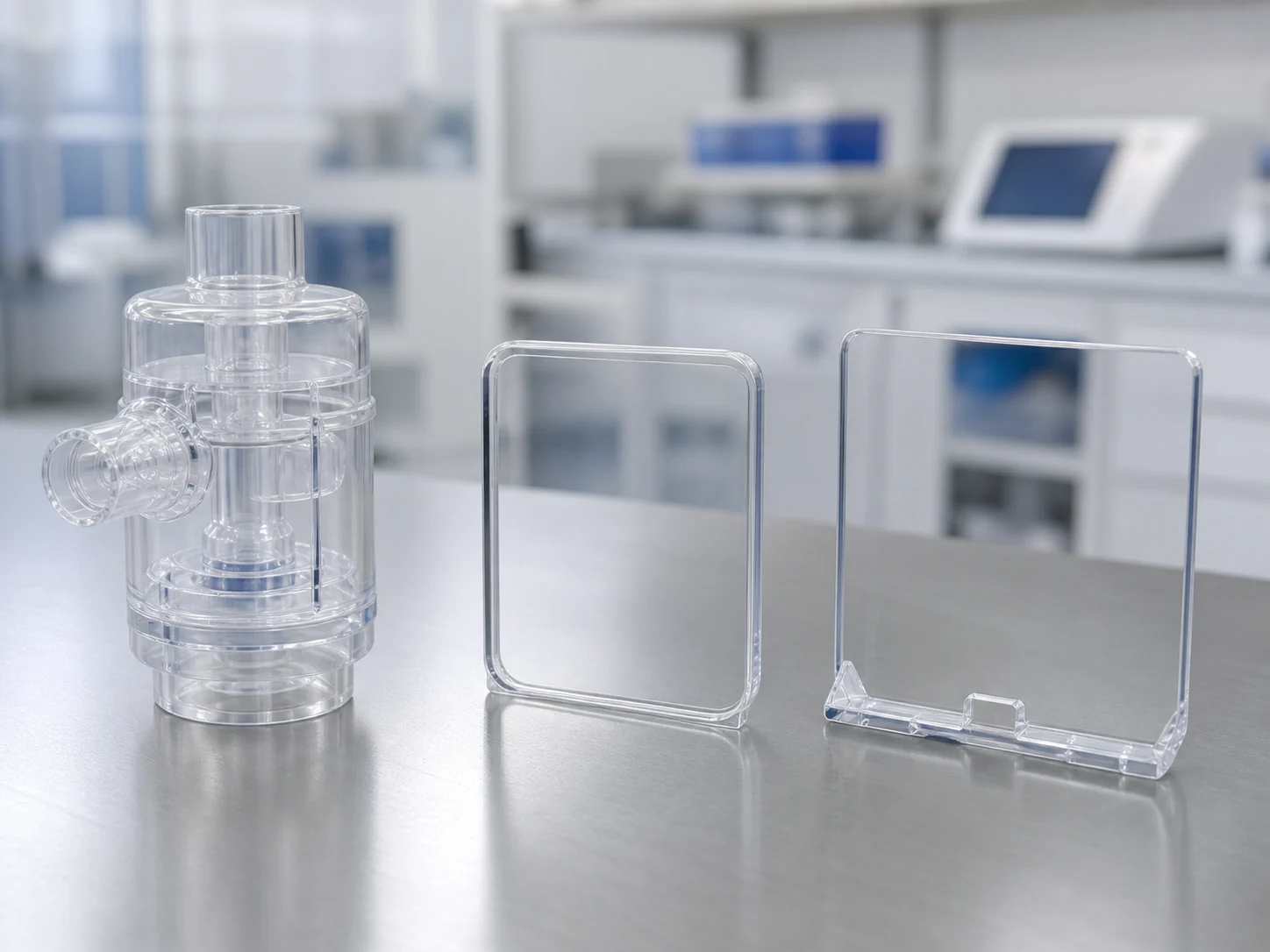
This material has been used in batch production for the customer's spacer chamber products. Customer feedback shows that chamber transparency meets atomization observation needs, medication adsorption is effectively controlled, and batch-to-batch antistatic consistency is good. The material uses brand-new modified resin, with a mature formulation and stable batch performance.
Medical-grade selection reference for transparent antistatic materials
At present, multiple transparent antistatic materials meeting medical-grade standards have entered application:
| Material Type | Representative Grade | Light Transmission | Surface Resistance | Core Features | Typical Medical Applications |
|---|---|---|---|---|---|
| Transparent antistatic ABS | DGK-ABS KJD890TM | 87% | Surface resistivity 10⁸-10⁹ Ω/□ | Balanced transparency and impact resistance, easy processing, resistant to disinfection wiping | Monitor panels, spacer chambers, equipment housings |
| Transparent antistatic PMMA | DGK-PMMA KJD890TM | >90% | 10⁹-10¹⁰ Ω | Optical-grade high transparency, high surface hardness | Medical observation windows, culture dishes, clear laboratory consumables |
| Transparent antistatic PC | Transparent antistatic PC series | 85-90% | 10⁸-10¹⁰ Ω | Very high impact strength, good heat resistance, dimensional stability | High-protection windows, clear equipment guards, sterile-room partitions |
Whether a medical project meets ISO 10993 biocompatibility, food-contact, BPA or 6P requirements must be checked against valid third-party reports for the exact grade, batch and end use. Transparency and antistatic data do not replace compliance evidence.
Selection summary
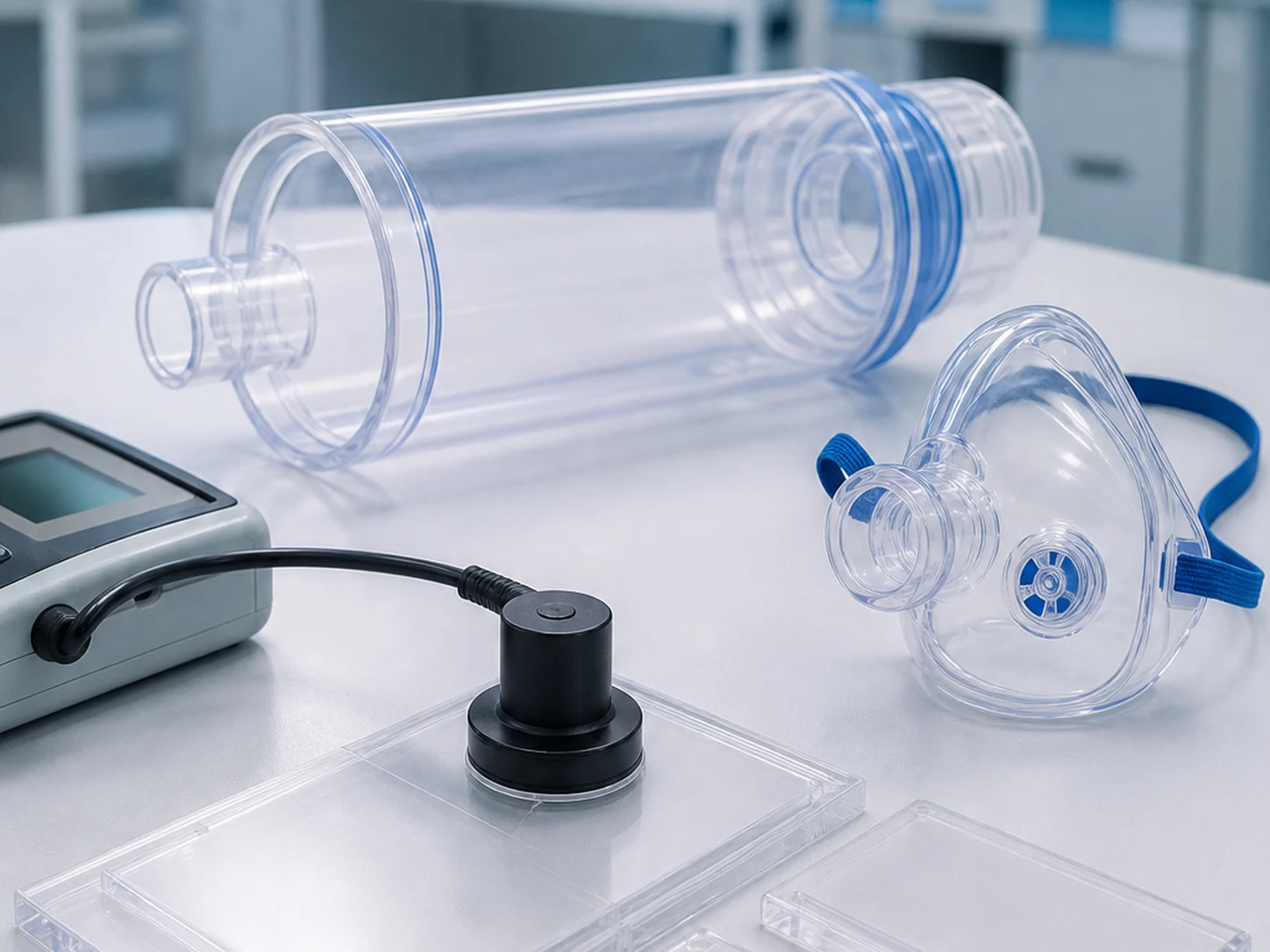
The essence of choosing transparent antistatic materials for medical devices is to solve static-related functional failure, inaccurate dosing, data interference and safety hazards while meeting clinical needs such as visual operation and improved efficiency.
For medical device projects that need stable transparency, wiping durability or dose consistency, Clearastatic provides small-batch validation from 5 kg, with sample delivery in 72 hours, and supports process tuning and mold design. Technical data and sample information can be obtained through Clearastatic official channels.